
When you run ads on a website, tracking your numbers is very important. You want to make sure your ad spots are making as much money as possible. A great number to look at is your Page RPM.
In this simple guide, you will learn what Page RPM means. You will learn the easy math to find your score. You will also learn clear steps to make this number grow right now.
What Is Page RPM In AdSense?
Page RPM shows how much money you earn for every 1,000 page views on your website. Every website has different traffic, so your score will look different from other sites.
This score is a great tool to measure your success. When you get many page views, your ads get a lot of attention. To make sure you hit your goals, you must know how to change your setups correctly.
How To Calculate Page RPM
To find your score, take your estimated earnings and divide that number by your total page views. Then, multiply the result by 1,000.
Here is the simple math formula:
RPM = (Estimated Earnings / Total Page Views) * 1000For example, if you make $15 from 1,500 page views, your math looks like this:
($15 / 1500) * 1000 = $10 RPM
What Influences Your RPM?
1. Click-Through Rate (CTR)
CTR measures how many clicks your ads get per 1,000 views. When your CTR goes up, your website revenue goes up too. More clicks mean more money for you. A high CTR tells advertisers that your ad spots are high quality.
- A higher CTR means your ads sit in excellent, highly visible locations.
- When you get more clicks, your overall website earnings jump up quickly.
2. Cost Per Click (CPC)
CPC is the exact amount of money you get paid every single time a visitor clicks an ad on your website. This shows how much cash an advertiser spends when you get a click.
- Your CPC changes depending on where your website traffic comes from.
- Certain specialized topics have a much higher payout than general topics.
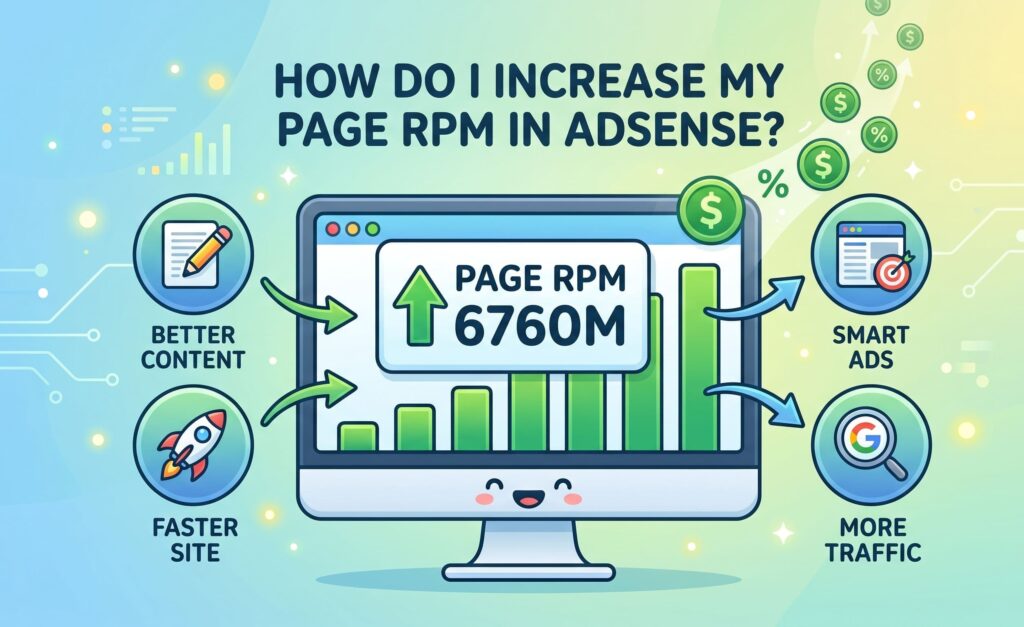
How To Increase Your Website’s Page RPM
When you try these new ideas, make sure to run your tests for at least one week to see the true results.
1. Write High-Quality Content
Great articles are the best way to get noticed online. Good content captures attention and keeps visitors on your pages. Write amazing posts to attract your audience. If you have boring text, your audience will leave your site fast.
- Answer the exact questions your audience is searching for online.
- Use simple words and short paragraphs so your text remains easy to read.
2. Show Related Articles
Give your visitors more links to click at the bottom of a post. This keeps your visitors on your website longer. More page visits give you a higher chance to get an ad click.
- Add a “Recommended for You” section at the bottom of every article.
- Link to your other helpful guides right inside your main sentences.
3. Make Your Website Fast
Clean up your website speed and fix your technical errors. A fast website creates a happy user experience. Speedy pages also load your ads faster, which saves you from losing money.
- Resize large images so your pages load instantly on mobile phones.
- Remove old or unused tools that slow down your background code.
4. Put Ads Where Users Can See Them
Advertisers do not want to pay for ads if visitors never look at your banners. Place your ads in bright spots where eyes naturally look.
- Place an ad directly inside your text where eyes naturally scan.
- Keep an ad near the top header so it stays visible right away.
5. Choose the Best Ad Sizes and Formats
Find a good balance for your layouts. Small ads do not get noticed, but huge ads distract your visitors. Test different choices like text, video, or display ads to see what works best.
- Use responsive ad blocks that automatically adjust to fit any screen size.
- Try classic banner shapes like 300×250 pixels because advertisers love them.
6. Target the Right Visitors
Focus on attracting visitors who care about your topics. Returning visitors give you a higher RPM because Google recognizes loyal fans easily. Paid traffic often leaves quickly and lowers your score.
- Build a helpful email list to bring your fans back to your site regularly.
- Share your links only in online spaces where people discuss your niche.
7. Use Header Bidding
Header bidding lets many ad networks compete for your ad spaces at the same time. The highest bidder wins the spot, so you automatically make more ad revenue. This method also helps your ads load faster.
- Connect your blog to premium ad networks once your traffic grows larger.
- Let different companies bid against each other to drive your ad prices up.
8. Get More Traffic from Google Search
When visitors find your website through a Google search, Google knows exactly what the search intent is. Advertisers pay more money for these clicks. Focus your time on traffic sources that bring you active visitors.
- Find low-competition keywords that are easy to rank for on search pages.
- Keep your titles clear and exciting so you win the most clicks.
Frequently Asked Questions (FAQ)
What Is Cost Per Click (CPC)?
CPC is the exact amount of money you receive every single time a visitor clicks an ad on your website.
What is a good Page RPM score?
Your final score depends on your website topic, but higher is always better. Most normal websites see an RPM between $2 and $10.
Does website speed change my RPM?
Yes. A fast website makes your visitors happy. Happy visitors stay longer and look at more pages, which raises your earnings score.
Can I click my own ads to raise my RPM?
No! Never click your own ads. Google will catch this right away and ban your account forever.
How long does it take to see my RPM go up?
Give your changes at least one week. Google needs time to test your new setups and show better ads to your visitors.
Why does my Page RPM drop sometimes?
Your score changes based on the season, where your traffic comes from, or if advertisers spend less money that month.
Conclusion
Increasing your AdSense Page RPM is all about making your website better for your visitors. When you write helpful stories, speed up your pages, and put your ads in the right spots, your earnings will grow. Choose one simple tip from this guide to try today, and watch your numbers go up!
