
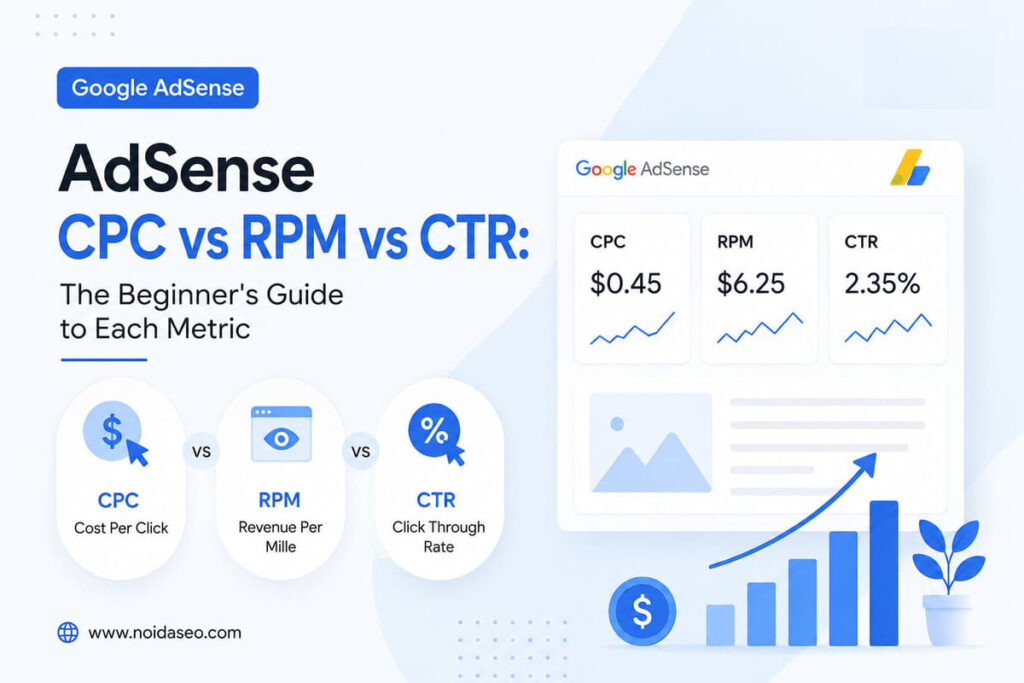
CPC, RPM, and CTR are the three numbers that explain your AdSense earnings. CPC is how much you earn per ad click. CTR is how often people click your ads. RPM is how much you earn for every 1,000 views, and it is the big picture number that ties the other two together. This guide explains each one in simple words, with an example.
When you first open your AdSense dashboard, these short letters can feel confusing. Once you know what each one means, your earnings start to make sense, and you know exactly what to improve.
What Is CPC?
CPC means Cost Per Click. It is the amount you earn each time a visitor clicks an ad on your site. Some topics pay far more per click than others, because advertisers in those fields earn a lot from each customer.
You raise your CPC by writing about high value topics. My guide on high CPC keywords lists 25 of the most profitable niches.
What Is CTR?
CTR means Click Through Rate. It is the share of ad views that turn into clicks, shown as a percentage. For example, if your ad is shown 100 times and gets 1 click, your CTR is 1 percent.
A higher CTR means more clicks from the same traffic. You improve it mainly with smart ad placement, putting ads where readers naturally look. One important rule: never ask people to click your ads or trick them into it. That breaks AdSense rules and can get your account banned.
What Is RPM?
RPM means Revenue Per Mille, where mille is just an old word for thousand. So RPM is how much you earn for every 1,000 views of your pages. It is the most useful single number, because it blends your CPC and your CTR into one figure.
To find your Page RPM, AdSense uses a simple idea. It takes your earnings, divides by your page views, then multiplies by 1,000. My guide on how to increase your page RPM goes deeper.
CPC vs RPM vs CTR: How They Work Together
Here is the easiest way to see all three side by side:
| Metric | Full name | What it measures |
|---|---|---|
| CPC | Cost Per Click | How much you earn per ad click |
| CTR | Click Through Rate | How often people click your ads |
| RPM | Revenue Per 1,000 Views | How much you earn per 1,000 page views |
Now here is a simple example that ties them together. Say in one day your site gets:
- 10,000 page views
- 100 ad clicks, which is a CTR of 1 percent
- a CPC of 0.50 dollars per click
Your earnings are 100 clicks times 0.50 dollars, which is 50 dollars. Your Page RPM is 50 dollars divided by 10,000 views, times 1,000, which is 5 dollars. So you earn 5 dollars for every 1,000 views. If you raise either your CPC or your CTR, your RPM goes up too.
How to Improve Each Metric
Each number has its own simple lever:
- CPC: write about high value topics and buyer intent keywords, so advertisers pay more per click.
- CTR: place ads where readers naturally look and keep your design clean, but never force or beg for clicks.
- RPM: improve the two above, and keep your content helpful so people read more pages per visit.
RPM is the number to watch, because it shows your overall earning power in one figure. You cannot raise it directly, so you raise it by improving CPC and CTR underneath it.
Common Mistakes to Avoid
- Thinking a high CPC alone means high earnings. You also need clicks and views.
- Trying to boost CTR by tricking visitors, which can get your account banned.
- Ignoring RPM, which is the clearest measure of how well your site earns.
- Comparing your RPM to other sites, when it varies a lot by niche and country.
Frequently Asked Questions
What is the difference between CPC and RPM?
CPC is what you earn from a single click. RPM is what you earn per 1,000 views, which includes many clicks. RPM gives the bigger picture.
Is a higher CTR always good?
A higher CTR usually means more earnings, but never try to force clicks. Tricking visitors breaks AdSense rules and can get your account banned.
What is a good RPM?
It varies a lot by niche and country, so there is no single good number. Compare your RPM to your own past results, not to other people.
How do I increase my RPM?
Raise your CPC with higher value topics, and raise your CTR with better ad placement. Both of these lift your RPM.
Does more traffic raise my RPM?
Not by itself. RPM measures earnings per 1,000 views, so it depends on your CPC and CTR, not on how many visitors you have.
Final Words
CPC, RPM, and CTR are not as confusing as they look. CPC is your pay per click, CTR is how often people click, and RPM is your overall earning power per 1,000 views. Watch your RPM as the main score, then lift it by improving the CPC and CTR beneath it.
To put this into action, read my guides on high CPC keywords to raise your CPC, and how to increase your page RPM to grow your overall earnings.
