
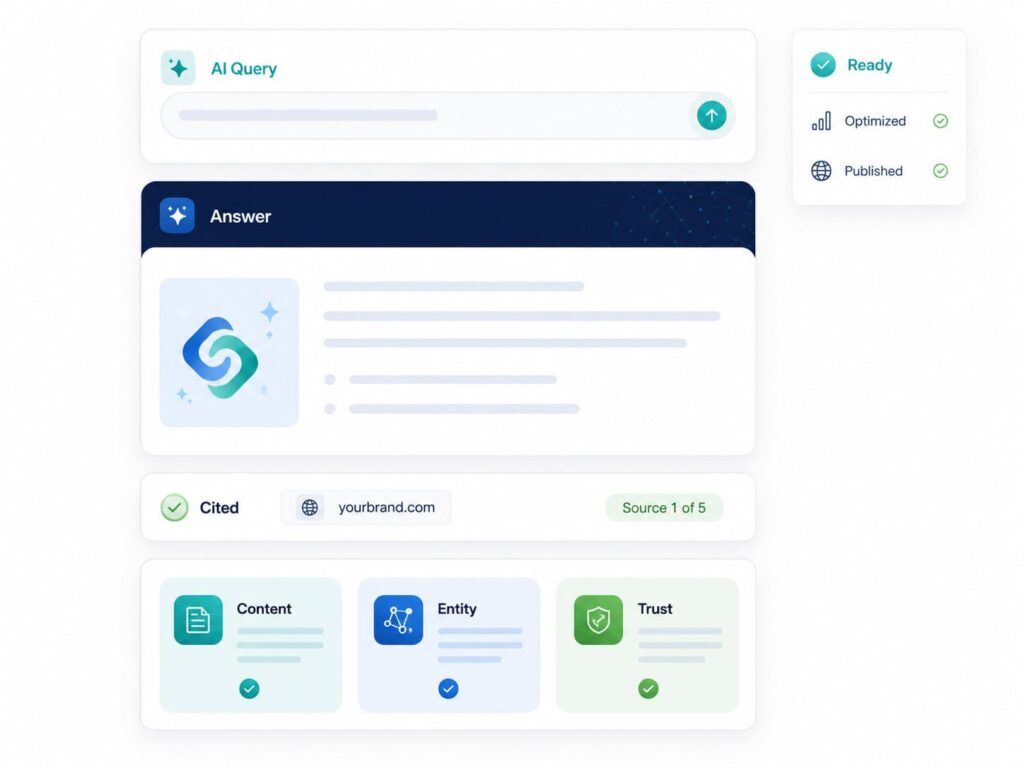
Generative engine optimization, or GEO, is the practice of writing and structuring your content so that AI tools like ChatGPT, Perplexity, and Google AI Overviews quote and cite it inside the answers they give. In plain words, GEO helps you become part of the answer, not just a link sitting below it.
If you have spent time learning SEO, you already have a head start. GEO does not throw any of that away. It adds a new layer on top, built for a moment when more and more people get their answers from an AI tool instead of a page of blue links. In this guide I will explain what GEO is, why it matters right now, and the exact steps a beginner can take to start getting cited by AI.
What Is Generative Engine Optimization?
Generative engine optimization is the process of shaping your content so that AI answer engines can find it, understand it, and use it as a trusted source when they write a reply. These engines include ChatGPT, Perplexity, Google AI Overviews, Gemini, and Claude.
The simplest way to picture the change is this. Traditional search hands you a list of links and asks you to click. A generative engine reads many sources, then writes one clear answer and names a few of them. With SEO your goal is to rank. With GEO your goal is to be cited. You want the AI to pull your words, your facts, and your name into the response it shows the user.
You may also see GEO called by other names, such as answer engine optimization (AEO), AI search optimization, or large language model optimization. The industry has not fully settled on one label yet, but the goal behind all of them is the same. Get your content used and credited by AI. If you want the full breakdown, I cover it in my guide on the difference between AEO, SEO, and GEO.
Why GEO Matters in 2026
A few years ago this was a niche idea. Today it is hard to ignore, and the numbers explain why.
People are clearly moving toward AI answers. By early 2026, AI search tools were handling an estimated 12 to 18 percent of English informational queries, up from under 2 percent a year before. ChatGPT alone now serves hundreds of millions of users every week. At the same time, Google AI Overviews appear above the normal results on a large share of searches, and roughly 65 percent of searches now end without anyone clicking through to a website at all.
That last figure is the one that should get your attention. If most searches end without a click, then simply ranking is no longer enough. You also need to be present inside the answer itself. The research firm Gartner has projected that traditional organic search traffic will fall by about 25 percent as people shift to AI powered tools, so this is a trend worth preparing for now rather than later.
There is also a money side to this story. In late 2025, Adobe agreed to buy the SEO company Semrush for around 1.9 billion dollars, a deal framed largely around visibility in AI search. When a company spends that much, it is a strong signal that GEO has moved from a buzzword to a real channel. The good news for you is that most websites have not caught up yet, so there is still room to get in early.
GEO vs SEO vs AEO: What Is the Difference?
Beginners often worry that GEO replaces SEO. It does not. The two work together, and they overlap a great deal. Here is a simple way to see how they compare.
| Approach | What it optimizes for | How you measure success |
|---|---|---|
| SEO | Ranking your page in the list of search results | Rankings, clicks, and organic traffic |
| AEO | Winning the direct answer box or featured snippet | Snippet wins and quick answer visibility |
| GEO | Getting cited inside an AI generated answer | How often AI tools mention or cite you |
Here is the honest takeaway. Google’s own guidance in 2026 says that optimizing for its AI features is still SEO at heart. Most experts treat GEO as an extra layer on top of solid SEO, not a separate world. So if your foundations are weak, fix those first. If you are new to all of this, start with my beginner guide on what SEO is and how it works, then come back here.
How AI Engines Choose Their Sources
To do GEO well, it helps to know what happens behind the scenes when someone asks an AI a question.
First, the engine often breaks the question into several smaller questions. This is sometimes called query fan out. Instead of searching for your exact sentence, it searches for the pieces of it. Then it retrieves real pages from the web, reads them, and writes an answer based on what it found. This retrieve then write method is why your page needs to be both easy to find and easy to understand.
The most useful finding for beginners comes from the original GEO study by researchers at Princeton, Georgia Tech, and the Allen Institute for AI. They tested what actually moves the needle and found that fact density, which means adding authoritative citations, statistics, and quotations, could lift the visibility of a lower ranked page by up to 40 percent inside AI answers. They also found that old tricks like keyword stuffing did nothing helpful and could even hurt. In short, AI rewards content that is genuinely informative, not content that is stuffed with the same phrase over and over.
How to Optimize Your Content for GEO
This is the part you can act on today. None of it is complicated, and each step makes your content better for human readers too.
1. Put the answer first
Open each section with a clear, direct answer in the first 40 to 60 words, then explain the details below it. AI engines love to pull a clean answer that stands on its own. Notice that I started this very article with a one paragraph definition. That is the technique in action.
2. Raise your fact density
Try to include a relevant fact, number, or data point every 150 to 200 words, and say where it comes from. Concrete facts give an AI something specific to quote, and they build trust with readers at the same time. Vague writing gets skipped.
3. Add credible citations and quotes
Link to and mention trustworthy sources inside your content, such as official documentation, research, or recognized industry data. This was the single strongest factor in the GEO research, so it is worth the effort.
4. Structure your content for easy reading
Use clear headings, short paragraphs, simple lists, and question style subheadings. The easier your page is to scan, the easier it is for an AI to pull a clean section out of it. My on-page SEO checklist walks through this kind of structure in detail.
5. Add schema markup
Schema is a small piece of code that tells search engines and AI what your content actually is, such as an article or a list of questions and answers. It helps machines read your page correctly. I show the exact steps in my guide on how to add schema markup in WordPress.
6. Strengthen your trust signals
AI tools favor content that looks credible. Show a real author with a short bio, display clear published and updated dates, and reference your sources openly. These are the same trust signals that good SEO already asks for, so you get double value.
7. Get your site into the right index
ChatGPT’s web search leans on Bing’s index, so make sure you submit your sitemap to Bing Webmaster Tools as well as Google Search Console. If the AI cannot find your page, it cannot cite it.
8. Earn mentions from other sites
When other respected websites mention or link to you, AI engines treat you as more trustworthy. So the old habit of building a real reputation across the web still pays off, just in a new way.
How GEO Works on Different Platforms
Each AI tool has its own personality, but the basics above apply everywhere. Here is a quick sense of the differences.
- Google AI Overviews: closely tied to normal Google ranking, so strong SEO and clear answers help the most.
- ChatGPT: uses Bing’s index for live results, so being indexed in Bing and having clear, factual pages matters.
- Perplexity: leans heavily on fresh, well sourced content and tends to cite its sources openly.
- Gemini: sits inside Google’s world, so the same quality and structure signals carry over.
How to Measure Your GEO Results
You cannot improve what you do not track, so set up a simple routine.
The easiest method is free. Make a short list of the questions your ideal reader would ask, then type them into ChatGPT, Perplexity, and Google AI Overviews once a month. Note whether your site is mentioned, how it is described, and which sources get cited instead of you. Over time you will see your presence grow as your content improves. If you want to go further, there are paid tools that track how often AI engines mention your brand, but the manual check is more than enough when you are starting out.
Common GEO Mistakes to Avoid
- Writing thin pages with no real facts or sources for an AI to quote.
- Stuffing keywords, which no longer helps and can work against you.
- Hiding your answer at the bottom of a long, rambling introduction.
- Skipping schema and clear structure, which makes your page harder to read.
- Publishing without a named author or visible dates, which weakens trust.
Frequently Asked Questions
Is GEO the same as SEO?
No, but they are close cousins. SEO helps you rank in search results, while GEO helps you get cited inside AI answers. Most of the time, good SEO makes GEO easier, so the two support each other.
Does traditional SEO still matter if I do GEO?
Yes. Strong SEO is the foundation. AI engines still rely on the open web to find sources, so a healthy, well optimized site gives your GEO efforts something solid to stand on.
How do I get cited by ChatGPT?
Make sure your site is indexed in Bing, write clear and factual content with sources, lead each section with a direct answer, and show real author and date signals. These steps give ChatGPT a reason to trust and quote your page.
Do I need to rank number one on Google to be cited by AI?
Not always. The GEO research found that even lower ranked pages can win citations if they are rich in facts and well structured. Quality and clarity can matter more than your exact position.
How long does GEO take to work?
It varies, but treat it like SEO and think in months, not days. As you publish clear, well sourced content and AI engines recrawl the web, your chances of being cited grow steadily over time.
Final Thoughts
GEO can sound intimidating at first, but the heart of it is simple. Write honest, useful, well sourced content, put your answers up front, and make your pages easy for both people and machines to read. Do that consistently and you give AI engines every reason to point to you.
The best part is that almost everything you do for GEO also makes your content better for real readers. If you want to keep going, read my guide on how to rank in Google AI Overviews next, and brush up on keyword research for beginners so you are targeting the right questions from the start.
