
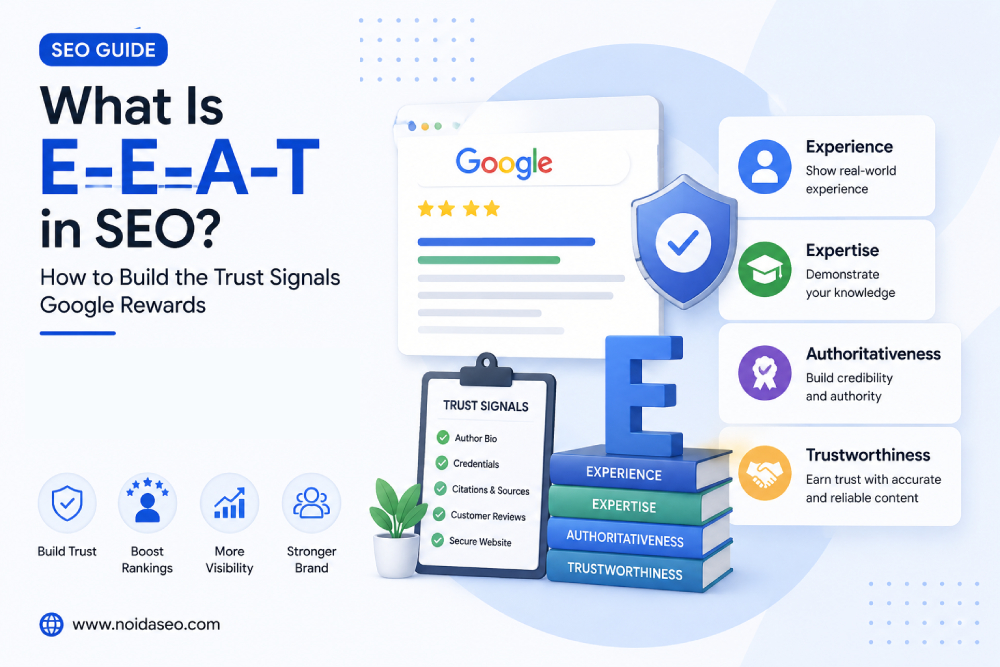
E-E-A-T stands for Experience, Expertise, Authoritativeness, and Trustworthiness. It is how Google judges whether your content can be trusted. Trust is the most important of the four. You build E-E-A-T by showing real authors, sharing real experience, giving accurate information, and running an open, honest site.
Google wants to show people content it can trust. E-E-A-T is the idea it uses to measure that trust. The good news is that the things that build E-E-A-T are simple and within your control.
What Does E-E-A-T Stand For?
E-E-A-T is made of four parts:
- Experience: have you actually done or used the thing you write about? First hand experience makes your content more believable.
- Expertise: do you have real knowledge or skill in the topic? Expert content is deeper and more accurate.
- Authoritativeness: are you a source people turn to? When other trusted sites mention or link to you, your authority grows.
- Trustworthiness: can people rely on your site to be honest, accurate, and safe? This is the most important part, and Google has said trust sits at the center of E-E-A-T.
Is E-E-A-T a Ranking Factor?
This is a common question, so here is the honest answer. E-E-A-T is not a single score that Google gives your page. It is a guide that Google’s reviewers and its systems use to judge quality. So you cannot see an E-E-A-T number anywhere.
But the signals that show E-E-A-T, like a real author and accurate content, do help your pages rank, especially on serious topics. So while E-E-A-T is not a button you press, it is very real in its effect.
Why E-E-A-T Matters in 2026
E-E-A-T matters more than ever, for two reasons. First, Google keeps raising the bar for quality, and it rewards content that clearly comes from real, trusted people. Second, AI search now leans on it too. Tools like Google AI Overviews mostly pull from sources with strong trust signals, so good E-E-A-T helps you get cited by AI as well. You can read more in my guide on how to rank in Google AI Overviews.
How to Build E-E-A-T: The Trust Signals
Here are the simple, practical ways to build each part:
- Show a real author. Put a name, photo, and short bio on each post, explaining why that person knows the topic. Hidden or fake authors weaken trust.
- Prove first hand experience. Share real examples, your own results, original photos, or steps you actually tried. This shows you have done the thing, not just read about it.
- Be accurate and cite sources. Get your facts right, and link to trusted sources to back them up. Fix any mistakes quickly when you spot them.
- Add your trust pages. Clear About, Contact, and Privacy pages tell Google and readers that a real, honest site stands behind the content.
- Keep your content fresh. Show clear published and updated dates, and update old posts so the information stays correct.
- Earn mentions and links. When trusted sites point to you, your authority grows. My guide on off-page SEO shows safe ways to earn them.
- Secure your site. Use HTTPS, the lock you see in the browser bar, so visitors know their connection is safe.
E-E-A-T and YMYL Topics
Some topics need extra care. Google calls them YMYL, which stands for Your Money or Your Life. These cover health, money, safety, and legal matters, where bad advice could really harm someone. On these topics, Google looks for very strong E-E-A-T, so be extra accurate, show real expertise, and be honest about what you do and do not know.
Common Mistakes to Avoid
- Hiding who wrote the content, or using fake authors.
- Copying facts without checking that they are true.
- Skipping an About, Contact, or Privacy page.
- Writing about serious topics with no real knowledge.
- Letting old posts go stale and out of date.
Frequently Asked Questions
What does E-E-A-T stand for?
Experience, Expertise, Authoritativeness, and Trustworthiness. They are the four things Google looks for to judge whether content can be trusted.
Is E-E-A-T a ranking factor?
Not as a single score. It is a guide for judging quality, but the signals that show E-E-A-T do help your pages rank, especially on serious topics.
Which part of E-E-A-T matters most?
Trust. Google has said trust sits at the center, and the other three parts all work to support it.
How do I improve my E-E-A-T fast?
Add a real author bio, show your sources, and publish your About, Contact, and Privacy pages. These are quick wins.
Does E-E-A-T matter for AI search?
Yes. AI tools mostly cite sources with strong trust signals, so good E-E-A-T helps you appear in AI answers too.
Final Words
E-E-A-T is really just Google’s way of asking a simple question. Can people trust this content and the person behind it? You answer yes by showing a real author, sharing real experience, keeping your facts accurate, and running an open, honest site. None of this is hard, and all of it makes your content better for readers too.
Start with a clear author bio and your trust pages, then build authority over time. To go further, learn what SEO is and how it works, and grow your authority with my guide on off-page SEO.
